
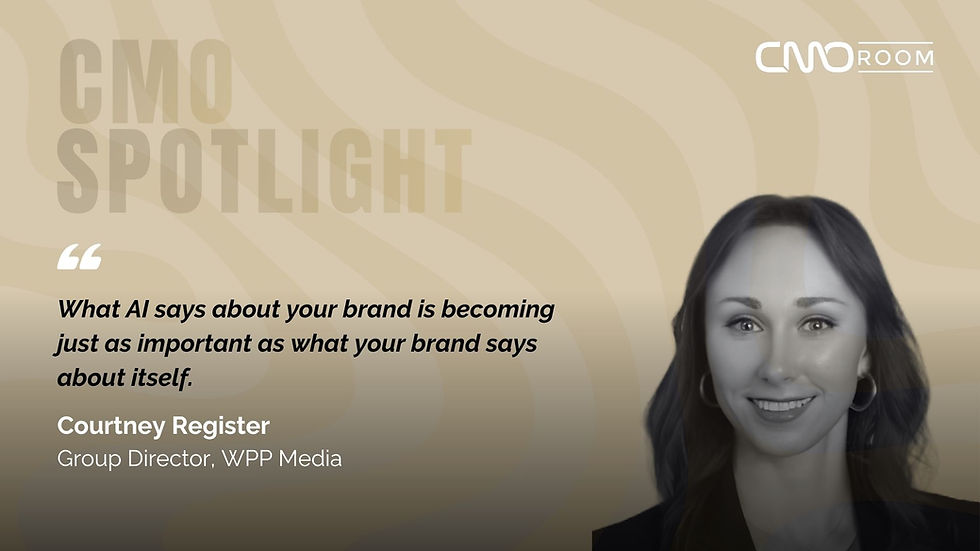
Courtney Register (Group Director @ WPP Media) AI, Human Insight & the Future of Strategy: What Leading Brands Need to Get Right
The future belongs to brands willing to test, learn, and adapt early.
AI may power the future, but human insight is still the real competitive advantage.
In this CMORoom Spotlight, we had the opportunity to sit down with Courtney Register, Group Director at WPP Media, to discuss how AI is transforming media agencies, redefining the role of strategists, and forcing brands to rethink authority, measurement, and digital reputation in an AI-first world.
Artificial intelligence is reshaping marketing at every level, from how consumers search and discover information to how brands build authority online. But while AI is accelerating change, the real competitive advantage still comes down to strategy, adaptability, and human insight. From the evolution of multimodal search to the growing importance of digital PR and holistic measurement, the conversation explores what brands need to embrace now in order to stay ahead over the next several years.
Q: From your perspective, how are large language models fundamentally changing the role of a strategist inside agencies today?
AI as a whole has really dissolved the traditional channel silos that existed previously. Agencies and marketing departments alike are redefining their role because what it takes to succeed today looks very different than it did even a year ago.
A lot of strategists are flexing into new roles and responsibilities, and everyone across organizations is actively upskilling. My background is in paid search, and even that space has evolved dramatically. Search is now multimodal, image-to-search, text-to-search, and it’s blending social, organic, and paid strategies together.
Because of that, teams are being encouraged to work much more collaboratively. Ultimately, everyone is working toward a more cohesive AI strategy for clients and businesses overall. In fact, AI is accelerating a broader rethink of agency business models and even the competitive landscape itself. As AI reshapes how ads are created, bought, and measured, agencies are evolving toward more platform-like operating models that unify creative, media, and production through shared technology and data infrastructure. We’re already seeing this direction take shape across the industry, including efforts like WPP Open, which is designed to bring AI capabilities across teams into a more connected system for building and optimizing work.
Q: What’s one misconception marketers still have about LLMs, and what should they focus on instead?
One of the biggest misconceptions is that AI is here to take everyone’s jobs. I don’t agree with that at all. AI is only going to replace you if you refuse to evolve with it. The challenge today is learning how to better ourselves and improve our client work using AI. The people who avoid it are the ones most likely to fall behind.
What really matters is building a human-led strategy around AI. AI still requires a tremendous amount of oversight and strategic thinking. You have to understand the data powering your overall approach and stay rooted in the client’s business objectives. AI should enhance your strategy, not replace the thinking behind it.
Q: Trust is everything in education and many other industries. How is AI influencing credibility and brand authority today?
Trust and authority are becoming even more critical because large language models are sourcing information from everywhere across the internet almost instantly. Brands no longer have complete control over their narrative. What other people say about your brand has never mattered more than it does now because AI systems pull from user-generated content, third-party websites, reviews, forums, and countless other sources.
That means brands need to think much more strategically about their digital PR efforts and their overall web footprint. You have to ensure the information available online accurately reflects your brand message and values.
And if inaccurate information exists, brands need to actively address it and build a trustworthy, authoritative voice across the web.
Q: It’s no longer just about optimizing for keywords, now brands also have to think about what AI is saying about them. How does that shift content strategy?
We still have to build content for humans first because that’s ultimately our job. But now we’re also creating content for the systems and AI models reading and interpreting that information.
Brands have to think about how their content is being sourced, summarized, and represented across AI-powered experiences. The challenge is making sure the narrative remains accurate and aligned with the voice the brand wants to project.
Q: Looking ahead, what will differentiate brands that successfully embrace AI from those that fall behind?
The biggest differentiator will be a willingness to test and learn. Brands that stay locked into “what works today” are the ones most at risk of falling behind. The landscape is evolving so quickly that companies need to stay agile and continuously experiment.
You never want to be testing from a place of panic because you waited too long. The brands ahead of the curve are the ones embracing experimentation from a position of strength. The second major differentiator is measurement. Many brands hesitate to fully embrace AI because they don’t have the right measurement framework in place.
Consumers interact with brands across countless platforms before making a purchase, and much of that journey is invisible to traditional last-click attribution models. Without a more holistic measurement strategy, brands will struggle to understand the true impact of their efforts and won’t have a complete picture of what’s driving growth.
As AI continues to redefine marketing, the brands that succeed won’t simply be the ones using the newest tools, they’ll be the ones building smarter, more agile strategies around them. This conversation with Courtney Register highlights a growing reality across the industry: AI may power the future, but human insight, experimentation, and trust will remain at the center of meaningful brand growth.
Stay tuned for more conversations from CMORoom Spotlight as we continue spotlighting the leaders shaping the future of marketing, media, and innovation.


